The Power of No: Why Camden's Makers Are Saying Less to Protect What Matters Most
There's a particular kind of dread that settles in when a message arrives asking you to make something that just isn't you. Maybe it's a bespoke order that would take three weeks and pay a fraction of what it's worth. Maybe it's a wholesale enquiry from a company whose values sit awkwardly against everything your work stands for. Maybe it's just a customer who wants to tweak your signature piece until it barely resembles itself anymore.
For a lot of makers — especially those just starting out — the instinct is to say yes. Always yes. Because bills exist, and rent in London doesn't care about your creative integrity.
But across Camden's studios, workshops, and market stalls, something interesting is happening. A growing number of craftspeople are learning to say no. And it's changing everything.
When 'Yes' Becomes the Problem
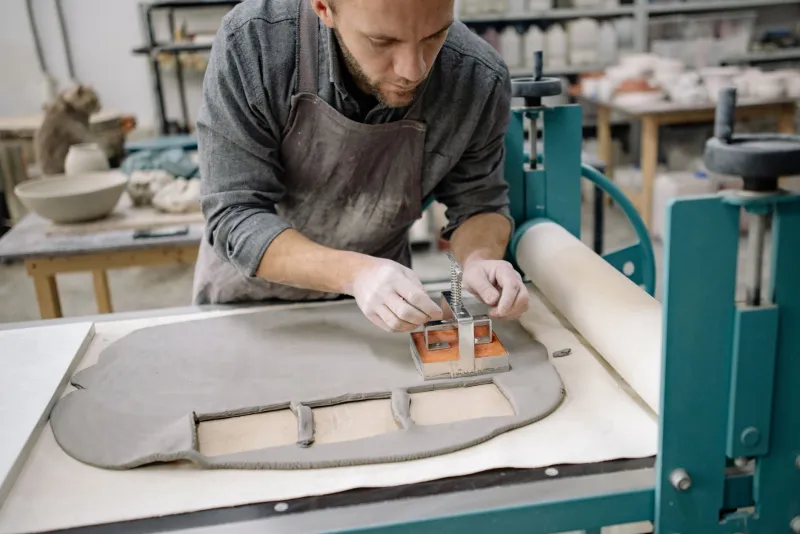
Sophie, a ceramicist who's been working out of a studio near Kentish Town for the past five years, remembers the period she describes as her "yes phase" with a kind of weary affection.
"I was taking every commission that came in," she says. "Personalised mugs, custom glaze colours I'd never worked with, pieces designed entirely by someone else. I was busy, technically. But I'd lost the thread of what I was actually trying to do."
The breaking point came when a corporate client asked her to produce 200 matching pieces for an office rebranding event — all identical, all in a colourway she found genuinely unpleasant. The money was decent. The work was numbing.
"I finished the order and looked around my studio and thought: I don't recognise any of this. None of it looked like mine."
She turned down the next corporate enquiry. Then another. And slowly, she says, the work she actually wanted to make started coming back to her.
The Commission That Didn't Fit
It's a story that echoes across Camden's maker community. Marcus, a woodworker based near Camden Lock, has a near-identical version — except his wake-up call came from a single conversation with a potential client who wanted him to reproduce a piece he'd seen online.
"He sent me a photo of something from a big furniture retailer. Wanted it in oak, wanted it in two weeks, wanted it cheaper than the retailer was selling it for," Marcus recalls, laughing slightly. "And I genuinely considered it. Because at the time, I thought that was just how you built relationships."
He didn't take the job. More importantly, he started thinking about why he'd nearly said yes to something that violated almost every principle he'd built his practice on. "I wasn't being asked to make something. I was being asked to copy something. That's not what I do."
He now has a simple filter: if a commission wouldn't sit comfortably in his portfolio, he won't take it. It sounds obvious. In practice, it took years to implement.
Protecting the Work by Protecting Your Time
Saying no to individual commissions is one thing. But some Camden makers have gone further — deliberately limiting how accessible they are, capping their customer base, or removing themselves from platforms that were generating volume but eroding value.
Leila, a textile artist who sells through her own website and a small number of carefully chosen stockists, stepped back from a major online marketplace two years ago after noticing that the platform's culture was reshaping her practice in ways she hadn't agreed to.
"The reviews, the race to the bottom on pricing, the expectation of constant availability — it was all pulling me in a direction I didn't want to go," she explains. "I was making things I didn't love, at prices that didn't reflect the work, for customers who'd found me by accident and wanted something slightly different."
Her sales dropped initially. She'd expected that. What she hadn't expected was how quickly the right customers found her anyway — people who'd specifically sought out her work, who understood what they were buying, and who rarely asked her to change anything.
"The funny thing is, I earn more now. Because I'm not discounting, I'm not rushing, and I'm not wasting time on enquiries that were never going to go anywhere."
The Guilt That Comes With It
None of this is easy to talk about, and the makers we spoke to were refreshingly honest about the emotional weight of turning work away. There's guilt — particularly when the person asking is enthusiastic, or when the money would genuinely help. There's anxiety about whether the next good opportunity will actually come. And there's a specific Camden-flavoured pressure that comes from operating in a community where everyone knows everyone, and word travels fast.
"You worry about the reputation," admits Sophie. "That you'll be seen as difficult, or precious, or not serious about your business. Because there's still this idea that a real business takes every opportunity it can get."
Marcus puts it differently. "Saying no feels like admitting you can afford to say no. And for a long time, I couldn't. So there's a class element to it as well — not everyone has the luxury of being choosy."
It's a fair point, and worth sitting with. The freedom to decline work is, in part, a financial freedom — and not every maker is in a position to exercise it. But several of the craftspeople we spoke to argued that strategic refusals, even early on, can be part of building toward that position rather than waiting until you arrive there.
Learning the Language of a Polite No
For many makers, the practical challenge isn't the decision itself — it's knowing how to communicate it without burning bridges or feeling like you owe someone a lengthy explanation.
Leila has developed what she calls her "kind redirect" — a short, warm response that acknowledges the enquiry, explains (briefly) why it's not the right fit, and sometimes points the person toward another maker who might suit them better.
"Camden's community is small enough that being decent about these things matters," she says. "The person you turn down today might be someone who recommends you tomorrow. Or they might become a customer when they find the right piece. You don't have to be cold about it."
Marcus simply says: "I've stopped over-explaining. 'That's not something I'm able to take on right now' covers most situations. You don't owe anyone a full breakdown of your creative philosophy."
What the No Actually Protects
Ask any of these makers what they were really protecting when they started saying no, and the answers are surprisingly consistent. Not just time. Not just money. Something harder to name — the specific quality of attention they're able to bring to their work when it isn't diluted by obligation.
"There's a version of my work that only exists when I'm making something I actually care about," says Sophie. "And that version is better. Customers can tell. I can tell. It's the difference between craft and production."
In a borough full of people making things with their hands and their whole selves, that distinction matters more than any spreadsheet. Camden's best makers aren't the ones who said yes to everything. They're the ones who figured out, sometimes painfully, what was actually worth their yes — and held the line on everything else.