Gloriously Flawed: How Camden's Makers Turned Their Rejects Into a Movement
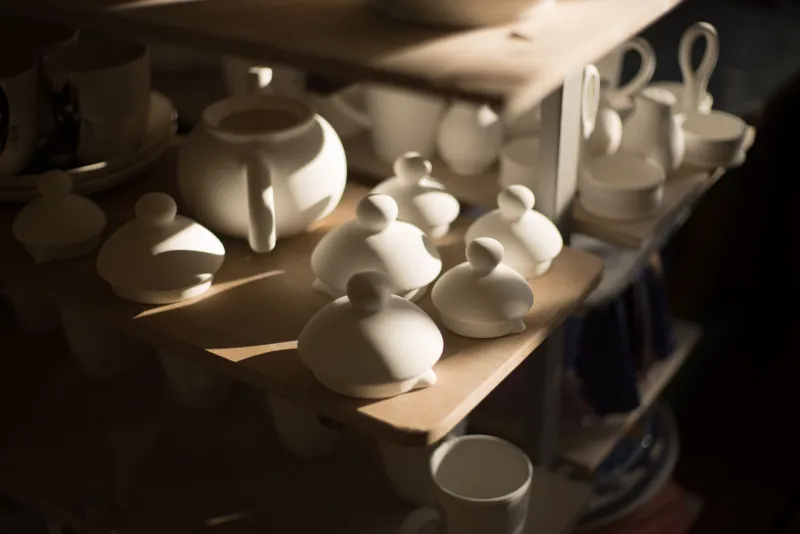
There's a box that lives under most makers' workbenches. You probably know the one — stuffed with pieces that didn't quite make the cut. A ceramic mug whose handle sits a few degrees off true. A leather wallet with a scuff that appeared from nowhere during finishing. A candle whose surface dimpled as it cooled. For years, that box was where handmade goods went to quietly disappear.
Something's changed, though. Across Camden's studios, markets, and online shops, makers are hauling that box out from under the bench and putting it on display. The 'seconds shelf' — once a source of mild embarrassment — has become, for a growing number of independent creators, one of their most beloved offerings.
What Actually Makes a 'Second'?
It's worth getting clear on what we're talking about, because the word 'second' covers a lot of ground. In a factory context, it usually means a product that failed a quality check — something genuinely defective. In the handmade world, the definition gets murkier, and that murkiness turns out to be rather interesting.
For Priya, a ceramicist who works out of a shared studio near Kentish Town, a second is anything she wouldn't feel comfortable selling at full price under her main label. "It might be a tiny air bubble that broke the surface during firing, or a colour that didn't develop the way I expected in the kiln," she explains. "Functionally, the piece is completely fine. It holds liquid, it's food-safe, it'll last decades. But it's not what I was going for, so it's always felt dishonest to sell it as if it were."
That commitment to transparency is actually what drives the whole seconds movement. These aren't damaged goods being quietly offloaded — they're honest goods being sold with full disclosure. And customers, it turns out, really respond to that honesty.
The Psychology of the Imperfect
There's a concept in Japanese aesthetics called wabi-sabi — a way of finding beauty in impermanence and imperfection. It gets cited a lot in craft circles, sometimes a bit lazily, but it does capture something real about why seconds resonate so deeply with people who love handmade objects.
When you buy a mass-produced item, perfection is the baseline expectation. Anything less is a failure. But when you buy something handmade, you're already buying into the idea that a human being made this — and humans are wonderfully inconsistent. A slight variation isn't a flaw in that context; it's evidence. It's proof that someone's hands were actually involved.
Marcus, who makes hand-stitched leather goods from a railway arch workshop in Camden, puts it plainly. "My firsts and my seconds come from the same hands, the same leather, the same hours of work. The difference is usually something so minor that most people couldn't spot it without being told. But I tell them anyway, and somehow that makes people trust me more, not less."
His seconds — sold at roughly 30 to 40 percent below his standard prices — sell out faster than almost anything else in his shop. He's started keeping a waiting list.
Waste Not: The Environmental Case
Beyond the aesthetics and the psychology, there's a straightforward environmental argument for the seconds shelf, and it's one Camden's more sustainability-minded makers are making loudly.
Handmade production isn't inherently zero-waste. Clay gets fired and can't be unfired. Leather gets cut and what's left over is offcuts. Candle wax, resin, dyed fabric — once these materials have been worked, there's no neat way to reclaim them if the finished piece doesn't sell. A piece that ends up in landfill represents not just wasted material but wasted energy, wasted time, and wasted skill.
Selling seconds keeps those pieces in circulation. It's not a perfect solution — nothing in sustainability ever is — but it's a meaningful one. Yemi, who produces natural dye textile pieces from her Camden studio, has made waste reduction a central part of her brand identity. Her 'B-Collection,' launched eighteen months ago, features pieces where the dyeing process produced unexpected results: colours that ran slightly, patterns that shifted, tones that came out deeper or lighter than planned.
"Every single one of those pieces is unique," she says. "The dye did what it wanted to do, not what I told it to do. I could have binned them. Instead, I've got customers who specifically wait for the B-Collection drops because they know they're getting something genuinely one-of-a-kind."
The drops sell out within hours.
A Community Built Around Beautiful Mistakes
One of the more unexpected outcomes of the seconds movement is the community that's formed around it. Makers who've been open about their imperfect pieces report that these items attract a particularly engaged type of customer — people who are genuinely curious about the making process, who ask questions, who come back.
Priya has started including a small card with each of her seconds, explaining what happened during the making and why she considers it a second rather than a first. "I thought it might feel like over-explaining," she admits. "But people love it. I get messages from customers saying the card is their favourite part. It makes the object feel like it has a story."
That storytelling dimension is something Camden's market culture has always been good at — the face-to-face exchange, the maker explaining their process, the customer understanding what they're actually buying. The seconds shelf extends that conversation into territory that's usually kept private: the experiments that didn't land, the kiln surprises, the dye that had other ideas.
Marcus has gone further still, hosting occasional 'seconds pop-ups' at his workshop where customers can come and hear about the pieces directly from him. "It started as a way to shift stock," he says, laughing. "Now it's basically a social event. People bring friends. They stay for ages. It's become one of the things I look forward to most."
What This Means for How We Value Handmade
The rise of the seconds shelf is, at its heart, a challenge to how we've been taught to think about quality. In a world shaped by mass production, quality became synonymous with uniformity — the idea that every item in a batch should be identical. Handmade has always struggled against that standard, and for a long time, many makers tried to compete on those terms, hiding variation rather than celebrating it.
What Camden's makers are doing now is something different. They're proposing an alternative definition of quality — one based on integrity, transparency, and the honest marks of human making. A second isn't a failed first. It's a piece with a slightly different story.
And if the waiting lists and the sold-out drops are anything to go by, plenty of people are ready to hear it.