From the Market to the Main Road: How Camden's Makers Are Rewriting Retail
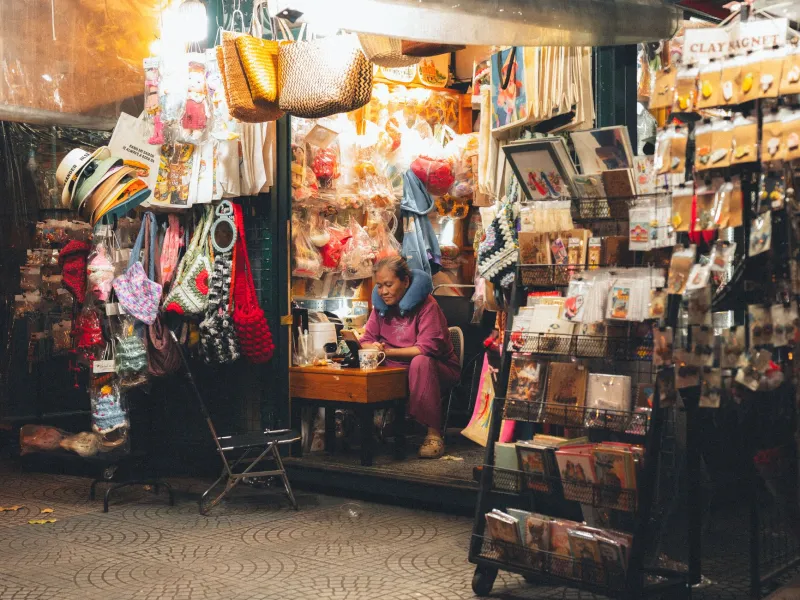
There's a particular kind of thrill that comes with walking into a shop and knowing that the person who made what's on the shelf might be standing right behind the counter. It's a feeling that's been largely absent from British high streets for the better part of two decades — but it's coming back, and Camden has a lot to do with that.
While retail analysts were busy writing obituaries for the independent shop, something quietly extraordinary was happening in NW1. A generation of makers — ceramicists, textile artists, jewellers, candle pourers, leather workers — was building real businesses from handmade foundations. And now, those businesses are moving outward, taking their goods, their ethos, and their unmistakable aesthetic into the wider retail landscape.
The Stall Was Never the Destination
Ask almost any Camden maker about their origin story and you'll hear a version of the same thing: a market pitch, a folding table, a card reader held together with optimism. For many, the stall was never the end goal — it was the laboratory.
"The market taught me everything," says Priya Nair, who makes hand-dyed silk scarves under her label Colour Ground. "I learned which colourways people actually stopped for. I learned how to talk about the process without it sounding like a lecture. By the time I was ready to approach shops, I already knew my customer."
Priya's scarves are now stocked in three independent boutiques in London and one in Edinburgh. She credits the discipline of market trading — the direct feedback, the relentless iteration — with preparing her for wholesale in a way that no business course could have.
That translation from stall to shelf isn't automatic, though. It requires a shift in thinking that not every maker finds comfortable. You're no longer just selling to one person at a time; you're selling to a buyer who's selling to many. The product has to work without you in the room.
Pop-Ups as Proof of Concept
Between the market and the permanent shop, there's a middle ground that Camden's makers have become particularly adept at navigating: the pop-up.
In the past few years, a cluster of makers from the Camden area have used short-term retail spaces — everything from empty shopfronts on the high street to concessions within larger independent stores — to test whether their work can hold its own in a conventional retail environment. The results have been striking.
Joe Adeyemi, who makes hand-thrown stoneware under the name Kiln & Kind, ran a six-week pop-up in a vacant unit near Camden Road last winter. He went in with modest expectations and came out with a waiting list.
"People would come in, pick something up, put it back down, and then come back two days later and buy it," he says. "There's something about a physical space that an online shop just can't replicate. The weight of the piece, the glaze in different light. You can't photograph that properly."
What Joe discovered — and what many makers are finding — is that the appetite for handmade goods in a physical setting is genuinely there. Consumers, worn down by the homogeneity of chain retail and the impersonality of fast delivery, are actively seeking something different. The pop-up gives makers a low-risk way to meet that demand, and it gives high streets a reason to exist again.
The Chain Store Problem
It would be naive to pretend that the revival of independent retail is happening in a vacuum. For every maker opening a pop-up, there are landlords still prioritising national chains, business rates still punishing small operators, and footfall still unevenly distributed across UK town centres.
But the cultural tide, at least, seems to be turning. Several large property developers have quietly begun courting independent and artisan retailers as anchor tenants — not out of altruism, but because they've noticed that handmade draws a crowd. The aesthetic of craft, the story behind the object, the sense that you're buying something that won't exist in identical form in every city in the country — these things have become genuine selling points.
"Chain stores can't compete on story," says retail consultant and longtime Camden market visitor Harriet Osei. "They can compete on price, on convenience, on brand recognition. But the one thing they absolutely cannot manufacture is authenticity. And that's exactly what independent makers have in abundance."
This isn't lost on the makers themselves. Several who spoke to us mentioned being approached by larger retailers about wholesale arrangements or branded collaborations — opportunities that come with a certain appeal but also a certain risk.
"You have to be careful," says Priya. "The moment you scale up to meet a big order, you can lose the thing that made people want your work in the first place. I've turned down a couple of deals because the numbers only worked if I started outsourcing production. That's not something I'm willing to do."
What Camden Brings to the Table
There's a reason this particular ecosystem developed here rather than somewhere else. Camden has always had a certain tolerance for the unconventional — a cultural permission to try things, to look different, to operate outside the mainstream. That spirit, baked into the borough's identity over decades, created the conditions in which creative businesses could take root.
But it's more than just atmosphere. The density of makers in Camden means there's genuine knowledge-sharing happening — informal networks of people who've navigated planning permissions, supplier relationships, and the peculiarities of London retail. When one maker figures something out, that knowledge tends to circulate.
That collective intelligence is part of what's making Camden's influence felt beyond its own postcode. Makers who cut their teeth here are carrying those lessons with them as they expand — into Hackney, into Peckham, into Bristol and Manchester and beyond. The Camden way of doing things, it turns out, travels.
The Bigger Picture
None of this is to suggest that Camden's makers are single-handedly saving the British high street. The structural problems — rates, rents, the gravitational pull of online shopping — aren't going away. But what's happening here is a meaningful proof of concept: that handmade, locally-rooted businesses can compete in conventional retail spaces, can build loyal customer bases, and can make a case for the kind of shopping experience that people actually want.
For Joe, the measure of success isn't units shifted or revenue targets. It's simpler than that.
"Someone came into the pop-up with their daughter," he says. "She was maybe seven or eight. She watched me trim a bowl for about ten minutes without saying anything. Then she turned to her mum and said, 'A person made that.' Like it was a revelation."
In a retail landscape that has spent years obscuring the human beings behind its products, that moment of recognition feels like something worth building on.