The Hidden Price of Playing Well With Others: When Maker Collectives Cost More Than They Give
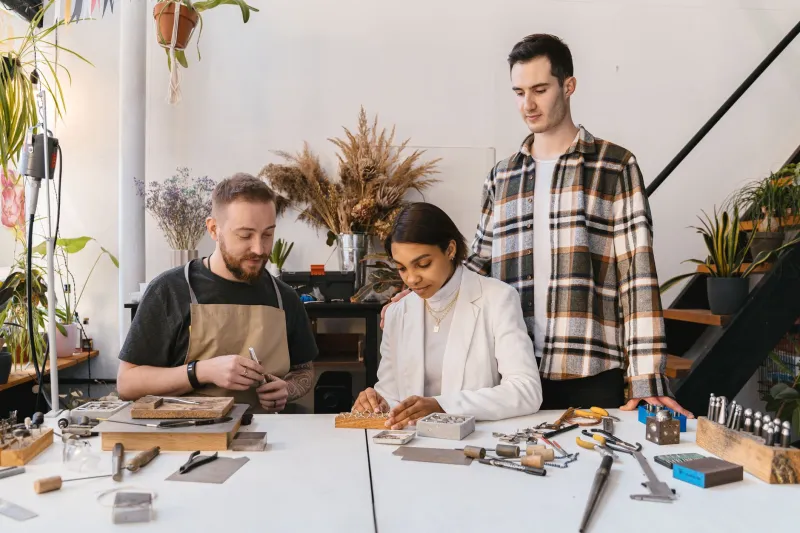
The image is a compelling one. A cluster of independent makers, sharing a light-filled studio, pooling resources, supporting each other's work, lifting the whole community higher. It's the kind of thing that gets written up in weekend supplements and makes for excellent grant applications. And sometimes — genuinely, wonderfully — it's exactly what it looks like.
But sometimes it isn't. And the gap between the romantic ideal and the complicated reality of collaborative working is something Camden's maker community doesn't talk about nearly enough.
This isn't a piece about collaboration being bad. It's about being honest that it isn't always good — and that the costs of getting it wrong can be significant enough to damage businesses that were perfectly viable on their own.
The Maths That Doesn't Get Shared
Shared studio spaces are perhaps the most common form of maker collaboration, and on paper the logic is sound. Split the rent, split the utilities, share the equipment, reduce individual overheads. For makers at an early stage, it can be genuinely transformative — access to space and tools that would otherwise be out of reach.
But the costs of sharing don't stop at the obvious line items. There's the time spent coordinating schedules — who has the space when, who's booked the kiln, who left the shared workbench in a state. There's the friction that builds when one person's production needs start to dominate the shared calendar. And there's the subtler drain of emotional labour: managing relationships with people you depend on professionally but don't always see eye to eye with.
"I spent about six months in a shared studio that looked amazing on paper," says Kit, a printmaker who now works from a smaller solo space in Camden. "The rent was lower than anything I could afford on my own. But I was losing probably four or five hours a week just to coordination — messages, rearranging, waiting for equipment to be free. When I actually costed that time, the 'cheaper' studio was costing me more than a solo space would have."
This is the accounting error that catches a lot of makers out. Time has a value. When collaborative arrangements eat into it, that value disappears quietly — it doesn't show up as an expense, but it absolutely shows up in output.
Unequal Contributions and the Resentment That Follows
Collaborative projects — joint product lines, co-designed collections, shared market stalls — introduce a different set of problems. Chief among them: the near-impossibility of equal contribution.
Makers bring different things to any shared endeavour. One person might have stronger design instincts; another might be better at production; a third might have the customer relationships that make the whole thing commercially viable. In theory, this complementarity is the point. In practice, it tends to generate an uncomfortable awareness of who's contributing what — and whether the split of costs, revenue, and credit reflects that reality.
"We did a joint collection with another maker I really respected," recalls Amara, a jeweller with a studio in Camden. "The idea was brilliant and I genuinely believe it was better than what either of us would have done alone. But the production split was never quite right — I ended up doing more of the detailed work, they did more of the promotion. Neither of us said anything until the end, and by then there was this residue of resentment that took ages to work through. We're still friends, but we've never collaborated again."
The absence of honest conversation at the outset is a pattern that repeats across Camden's collaborative landscape. Makers who are good at making things are not always good at negotiating terms, discussing money, or raising concerns before they fester. The creative warmth of the early stages of a collaboration can make those conversations feel unnecessarily transactional — and so they get deferred until the damage is already done.
When Community Has a Price Tag
There's also a broader, less tangible cost to consider: the way that belonging to a collective or shared community can subtly constrain individual creative and commercial decisions.
Accepting a wholesale deal that a collective peer disapproves of. Raising prices in a way that creates an uncomfortable disparity. Pivoting your product range in a direction that doesn't fit the group's shared aesthetic. These are all legitimate business moves that become loaded when you're embedded in a community with its own norms and expectations.
"I felt like I needed permission," admits one Camden maker who asked not to be named. "Not formally — nobody was telling me what to do. But there was this implicit sense of what the collective stood for, and I'd started to feel like my own ambitions were slightly outside that. It took me a while to realise that I'd been making decisions based on what the group would think, rather than what was right for my business."
This is perhaps the most insidious cost of collaborative community: the way it can quietly erode the independent judgment that makes individual makers distinctive in the first place.
So When Does Collaboration Actually Work?
None of this means makers should retreat into isolation. The Camden independent scene is genuinely stronger for its networks, its shared knowledge, and its culture of mutual support. But there's a difference between community and formal collaboration — and the latter deserves the same rigorous cost-benefit thinking as any other business decision.
The collaborations that tend to work are the ones that start with explicit conversations about contribution, credit, and exit. They involve makers whose working styles and values genuinely align — not just aesthetically, but operationally. And they're structured with enough flexibility to accommodate the reality that people's needs and capacities change.
The ones that don't work tend to start with enthusiasm and an assumption that goodwill will sort out the details. It rarely does.
Camden's maker community has built something genuinely remarkable — a culture of creative solidarity that most commercial districts would struggle to manufacture. Protecting that culture means being honest about when formal collaboration serves it, and when it quietly undermines the very independence that makes it worth protecting in the first place.